
New Type Infrastructure: Industrial Policy for the Digital Age

“The construction of New Type Infrastructure… must be accelerated. This is not only an inherent requirement for strengthening Cyber Great Power, but also the fundamental prerequisite for Building Digital China and developing our country’s information industry.”
“CAE Academician Liu Yunjie Explains Cyber Great Power Layout in 14th Five-Year Plan,” Outlook Weekly, January 27, 2021
China’s New Type Infrastructure (新型基础设施) is the Party’s core industrial policy framework for the digital age. As a formal Party tifa (term-of-art), it describes a strategic, systemic program to build the digitalized ecosystem required for National Informatization. It is also directly linked to China’s three elite digital strategies—Cyber Great Power, Digital China, and Smart Society—as a critical “means” enabler. Despite its strategic significance, New Type Infrastructure remains poorly understood outside China. Much of this stems from persistent mistranslations that flatten the Party term-of-art into generic English.
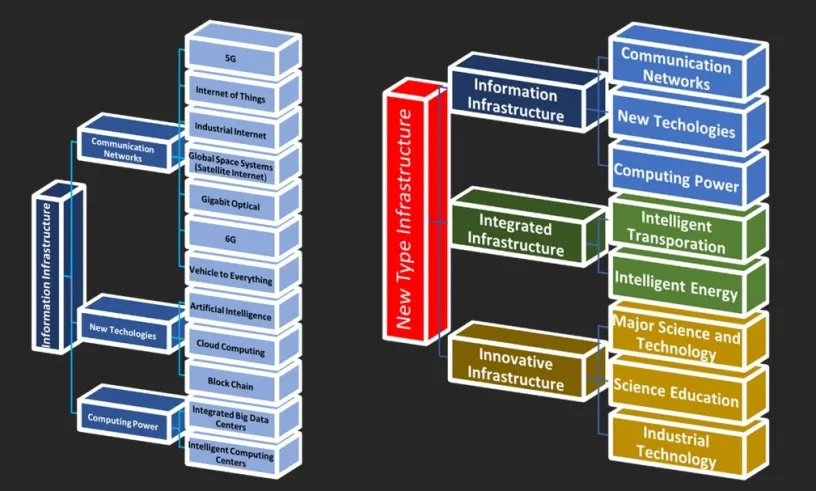
The logic of “full-stack” innovation and developing a “full-stack” architecture to support China’s elite digital strategies was cemented when New Type Infrastructure was publicly defined by the National Development and Reform Commission (NDRC) on April 20, 2020. Rather than viewing digital technologies like computing power, artificial intelligence, big data, and gigabit optical as separate domains, the NDRC formally reconceptualized them as interdependent elements of New Type Infrastructure and essential drivers of “Digitalized Development.”
In English-language discourse, including PRC state-run English-language media, the formal tifa of New Type Infrastructure (NTI) is often diminished in translation to the generic “new infrastructure.” This linguistic flattening collapses three distinct infrastructure categories into an ambiguous whole. When translated generically into English as “new infrastructure,” there is simply no way to distinguish between infrastructure in China that has been: (1) “newly” installed, (2) other types of new infrastructure (like roads or an airport), or critically, (3) advanced digital infrastructure designed to support the Party’s elite national digital strategies.
Because these concepts are rendered identically in English, the underlying strategic intent of NTI is washed away. Within PRC state-run English-language media, this lack of precision likely serves as a calculated form of obfuscation, ensuring the true scale and intent of the program remains hidden in plain sight.
Continue Reading at [Digital China Wins the Future]
Why the extra click? It isn’t a gimmick or a paywall trap. The website is completely free. It is simply the best way for me to maintain an organized library; it’s easier for me to manage and better for search engines and future research.
While this Substack provides a curated selection of my analysis, Digital China Wins the Future is where the full “stack” lives, including strategy milestones, primary source translations, news updates, and working aids.
Which should you choose?
The Substack: If you want the “highlights,” stay right here. The same goes for subscriptions.
The Website: If you are a Digital China nerd and want the full deep-dive archive, the website is your better pick.